Mechanical Seals Used in Pharmaceutical Manufacturing
February 18, 2026•5 min read
Hygiene and Sterility Requirements
Pharmaceutical manufacturing demands absolute control over contamination, making mechanical seals a critical component in maintaining sterile processing environments. Any leakage, crevice, or material incompatibility can compromise product quality and lead to batch rejection, regulatory scrutiny, or costly production downtime.
Mechanical seals used in pharmaceutical applications must be designed with smooth surfaces, minimal dead zones, and materials that do not support microbial growth. Traditional industrial seal designs often contain gaps or geometries that are difficult to clean thoroughly, making them unsuitable for pharmaceutical use.
For this reason, pharmaceutical manufacturers prioritise sealing solutions that are specifically engineered for hygienic applications, ensuring product integrity throughout production, cleaning, and sterilisation cycles.
Importance of Cleanable and Hygienic Seal Design
Beyond basic leakage control, hygienic mechanical seal design plays a central role in pharmaceutical equipment performance. Seals must allow complete access for cleaning fluids and steam during sanitisation processes, without trapping residues or cleaning agents.
Seal geometries that support effective drainability and surface contact with CIP fluids help prevent cross-contamination between batches. Poorly designed seals can become hidden contamination points, even if the seal itself does not visibly leak.
Hygienic design is therefore not optional in pharmaceutical manufacturing—it is a fundamental requirement tied directly to product safety, process repeatability, and regulatory acceptance.
CIP and SIP Compatibility
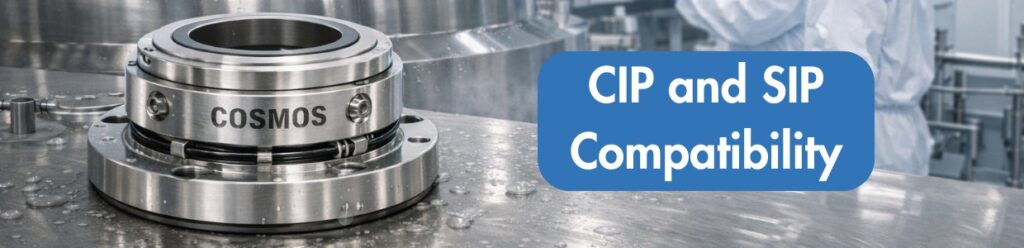
Clean-in-Place (CIP) and Sterilise-in-Place (SIP) cycles are integral to pharmaceutical manufacturing. Mechanical seals for pharmaceutical equipment must withstand repeated exposure to high-temperature steam, aggressive cleaning chemicals, and pressure variations without degradation.
During CIP and SIP cycles, seals experience thermal expansion, pressure changes, and chemical attack that can exceed normal operating conditions. If seal materials or designs are not compatible with these cycles, issues such as face distortion, elastomer hardening, or leakage can occur.
Pharmaceutical-grade seals are designed to maintain sealing integrity throughout repeated CIP/SIP cycles, ensuring that cleaning and sterilisation processes do not compromise seal performance or sterility.
Agitator Seal Importance in Pharmaceutical Processes
Agitators Seals and mixers are essential in pharmaceutical reactors, blending vessels, and formulation tanks. Agitator mechanical seals in pharmaceutical manufacturing must accommodate axial shaft movement, vibration, and pressure changes while maintaining sterile separation between the product and the environment.
Unlike standard pump seals, agitator seals must manage dynamic conditions created by mixing forces and variable batch volumes. Inadequate agitator sealing can result in leakage, contamination, or loss of sterility during production or cleaning cycles.
Selecting the correct agitator seal design is critical for maintaining consistent product quality, especially in high-value pharmaceutical batches where failure can lead to significant financial loss.
Material Selection for Pharmaceutical Mechanical Seals
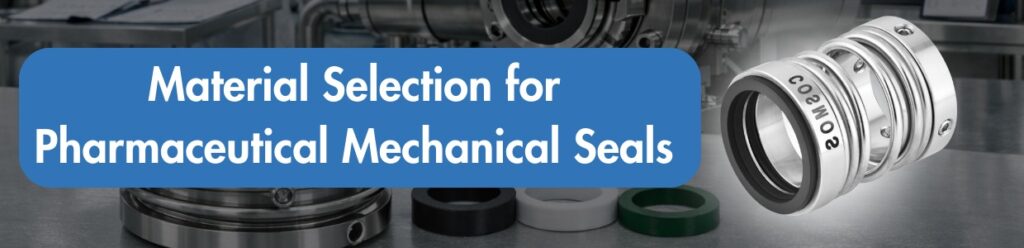
Material selection is one of the most important factors in mechanical seals used in pharmaceutical manufacturing. Seal face materials and elastomers must be chemically compatible with process media, cleaning agents, and sterilisation methods.
Materials must resist chemical attack, thermal cycling, and wear while maintaining dimensional stability. Incompatible materials can degrade over time, leading to leakage, contamination, or compliance issues.
Manufacturers with pharmaceutical application expertise evaluate material compatibility in detail, ensuring long-term seal reliability and compliance with hygienic processing requirements.
Regulatory Expectations and Audit Readiness
Pharmaceutical manufacturing is governed by strict regulatory frameworks that place strong emphasis on contamination control, equipment design, and process validation. Mechanical seals are routinely reviewed during audits as part of overall equipment compliance.
Regulatory authorities expect sealing systems to demonstrate consistent performance, cleanability, and traceability. Seal failures or leakage events can raise concerns about process integrity and lead to corrective actions or production delays.
Using mechanical seals designed specifically for pharmaceutical applications helps support audit readiness, reduce compliance risk, and ensure uninterrupted manufacturing operations.
Validation and Documentation Considerations
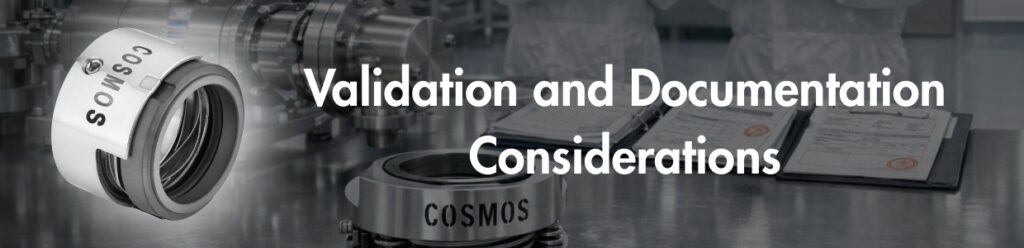
Beyond physical performance, pharmaceutical manufacturers also require documentation support for equipment components, including mechanical seals. Validation protocols often require material details, performance consistency, and traceability.
Seals used in validated processes must demonstrate repeatability across batches and replacement cycles. Inconsistent seal performance or undocumented design changes can trigger revalidation requirements.
Working with manufacturers who understand pharmaceutical validation expectations helps simplify documentation processes and supports long-term operational stability.
Conclusion and Call to Action
Mechanical seals used in pharmaceutical manufacturing must meet the highest standards of hygiene, sterility, CIP/SIP compatibility, and regulatory compliance. Proper seal design, material selection, and application evaluation are essential for protecting product quality and ensuring reliable production.
Cosmos Seals provides mechanical seals for pharmaceutical manufacturing, including hygienic cartridge seals, agitator mechanical seals, and custom-engineered sealing solutions designed for sterile processing environments. With strong application expertise and controlled manufacturing, Cosmos Seals supports pharmaceutical companies with reliable, compliance-ready sealing systems.
📞 Call us at +91 9769133001 📧 Email us at info@cosmosseals.com 🌐 Visit www.cosmosseals.com
Frequently Asked Questions
Q1: Why are standard industrial mechanical seals unsuitable for pharmaceutical applications?
A1: Standard seals often lack hygienic design and CIP/SIP compatibility required for sterile pharmaceutical processing.
Q2: How do CIP and SIP cycles affect mechanical seal performance?
A2: CIP/SIP cycles expose seals to high temperatures and chemicals, requiring materials and designs that resist thermal and chemical stress.
Q3: Why are agitator seals critical in pharmaceutical manufacturing?
A3: Agitator seals must maintain sterility while handling axial movement and dynamic mixing forces.
Q4: Do pharmaceutical mechanical seals require special documentation?
A4: Yes, documentation and traceability support validation, audit compliance, and process consistency.
Why Industries Don’t Just Pick Any Mechanical Seal Supplier When industrial buyers search for a list of mechanical seal manufacturers, they are usually trying to avoid operational risk rather than simply comparing prices. Mechanical seals directly affect equipment uptime because pumps, agitators, and compressors cannot function reliably if sealing performance is unstable. Whether it is […]
We are proud to share that Cosmos Seals India Pvt. Ltd. has been featured in Industry Outlook Magazine under the title: “Cosmos Seals India – A Trusted Manufacturer & Exporter Of Premium Quality Seals With Seamless Finish.” This feature highlights the company’s growing presence in the industrial sealing solutions sector and also recognizes the leadership […]
Cost vs Performance Balance For purchase managers, mechanical seals are often evaluated primarily on unit price, especially when procurement targets are cost-driven. However, mechanical seals are not commodity items; they are precision-engineered components whose performance directly influences equipment uptime, safety, and maintenance costs. A lower-priced seal may appear attractive during procurement, but if it is […]
Overview of Pump Sealing Systems Industrial pumps operate in demanding environments where controlling fluid leakage is essential for safety, efficiency, and equipment longevity. Pump sealing systems play a critical role by preventing process fluids from escaping along the rotating shaft while allowing smooth, reliable operation. Among available sealing options, mechanical seals are the most widely […]
Why Seals Fail Prematurely Premature Mechanical seal Failure is one of the most persistent reliability challenges in industrial operations. Mechanical seals are engineered components designed to operate under tightly defined conditions, yet in real-world environments, they are often exposed to variables that exceed their design assumptions. When this happens, even high-quality seals can fail much […]