List of Mechanical Seal Manufacturers | How Industrial Buyers Identify Reliable Suppliers
April 6, 2026•10 min read
Why Industries Don’t Just Pick Any Mechanical Seal Supplier
When industrial buyers search for a list of mechanical seal manufacturers, they are usually trying to avoid operational risk rather than simply comparing prices. Mechanical seals directly affect equipment uptime because pumps, agitators, and compressors cannot function reliably if sealing performance is unstable. Whether it is a component seal used in standard pumps or advanced cartridge seals installed in critical applications, the wrong choice can lead to frequent failures.
In continuous-process industries, a leaking seal does not just require replacement — it can stop production, contaminate processed material, and create safety concerns for operators. For example, an incorrectly selected agitator seal in a chemical reactor can result in leakage of hazardous fluids, impacting both safety and product quality. This is why supplier selection becomes a maintenance-driven decision rather than a basic purchasing activity.
Plants often discover that repeated seal failures are not caused by poor equipment but by incorrect seal selection or unsuitable materials. Many suppliers provide replacement parts based only on dimensions, without evaluating operating conditions. This leads to a cycle of repeated leakage, frequent shutdowns, and rising maintenance costs. In such cases, even high-performance products like Metal Bellow Seal or Multi Spring Seal fail prematurely due to improper application.
This is where engineered solutions such as a seal support system play a crucial role. By maintaining proper lubrication, cooling, and pressure conditions, these systems significantly improve seal life and reliability. Buyers therefore begin by reviewing multiple manufacturers so they can identify suppliers capable of understanding real operating requirements rather than simply supplying parts.
Why Most Supplier Lists Don’t Solve the Real Problem
Many online directories and catalog listings simply provide company names without explaining how to evaluate them. However, choosing a sealing supplier requires technical assessment. Industrial equipment operates under specific conditions such as temperature variation, fluid compatibility, pressure, and shaft movement. A supplier who cannot analyze these parameters may still supply a seal, but the equipment may continue to fail.
For instance, selecting a Teflon Bellow Seal without considering chemical compatibility or temperature range can result in rapid degradation. Similarly, installing a Double Cartridge (DC20) without proper pressure balancing can lead to leakage despite its advanced design. This highlights why product availability alone is not enough.
Maintenance teams often realize that the real difference between suppliers is not product range but application understanding. A manufacturer who asks questions about operating media, speed, temperature, and alignment is more likely to provide a stable sealing solution. Whether it involves choosing between a component seal or a pre-assembled cartridge seals system, correct evaluation makes all the difference.
A supplier who ships parts immediately without technical evaluation may appear convenient but often leads to repeated replacement cycles. Over time, industries realize that a list of suppliers is only the starting point — the real value lies in identifying those who provide engineering-based recommendations and long-term reliability solutions.
What Separates Reliable Manufacturers from Ordinary Suppliers
A reliable mechanical seal manufacturer does more than provide spare parts. They help identify the cause of leakage, recommend correct configurations, and support installation practices. Instead of supplying a generic replacement, they evaluate operating conditions and choose suitable materials and designs.
For example, a reliable supplier may recommend a Multi Spring Seal for high-pressure applications or a Metal Bellow Seal for handling high-temperature fluids where elastomers are not suitable. In agitator systems, they may suggest a Single Agitator (ASC10) or a specialized agitator seal depending on shaft movement and mixing conditions.
Plants typically notice three major differences. First, reliable manufacturers analyze the application before recommending a seal. Second, they provide consistent dimensional accuracy and material quality. Third, they offer technical support when maintenance teams face recurring problems.
Additionally, advanced solutions like a seal support system are often recommended by reliable manufacturers to improve performance in demanding applications. These systems help control temperature, flush contaminants, and stabilize pressure conditions, significantly enhancing seal life.
Suppliers who lack these capabilities often create hidden operational costs. Even if the initial seal price is lower, repeated replacements and downtime increase total maintenance expenses. Over time, maintenance teams prefer suppliers who reduce failures rather than those who only provide quick delivery.
The Role of Engineering Guidance in Seal Reliability
Seal performance depends heavily on the operating environment. Factors such as shaft vibration, improper alignment, pressure fluctuation, and temperature variation can affect performance. Without understanding these parameters, even a high-quality seal may fail prematurely, regardless of whether it is a component seal or a more advanced sealing solution.
This is why engineering guidance becomes critical. A manufacturer who understands when to use a component seal, when to shift to cartridge seals, or when an agitator seal is required can significantly improve equipment reliability. For complex systems, integrating a seal support system ensures stable operation by maintaining proper lubrication, flushing, and cooling conditions, which directly enhances seal life and performance.
Manufacturers who provide engineering support also help select the right product for each application based on real operating conditions. For example, a Teflon Bellow Seal is highly effective in corrosive chemical environments where material compatibility is critical, while a Multi Spring Seal is better suited for high-pressure applications requiring uniform load distribution. In high-temperature conditions where elastomers may fail, a Metal Bellow Seal offers superior reliability. Similarly, for applications demanding zero leakage and higher safety, a Double Cartridge (DC20) provides enhanced sealing integrity, whereas a Single Agitator (ASC10) is specifically designed for mixing and reactor systems where shaft movement and process conditions are more complex.
With correct engineering guidance, maintenance teams can shift from reactive replacements to preventive maintenance strategies. Instead of repeatedly changing failed seals, they can implement solutions that align with operating conditions, significantly reducing emergency shutdowns and allowing better planning of servicing intervals.
In many plants, the turning point occurs when maintenance teams move from repeatedly replacing seals to solving root-cause problems. Once proper sealing configurations, including the right selection between cartridge seals, agitator seal, and supporting systems like a seal support system, are implemented, equipment stability improves, downtime reduces, and overall operational efficiency increases
Industrial buyers increasingly prefer manufacturers who understand equipment applications rather than those who only supply catalog products. In real industrial environments, no two applications are exactly the same. Pumps handling corrosive chemicals behave very differently from those handling clean water, and mixing systems require completely different sealing approaches compared to standard rotating equipment. This is where the choice between a component seal, cartridge seals, or a specialized agitator seal becomes critical.
Application-focused manufacturers take the time to study these conditions before recommending a solution. Instead of offering a standard product, they evaluate factors such as fluid properties, pressure conditions, temperature range, and shaft dynamics. For example, in chemical industries, a Teflon Bellow Seal may be recommended due to its resistance to aggressive media, whereas high-load industrial pumps may perform better with a Multi Spring Seal for enhanced stability.
Another major advantage is the ability to standardize sealing solutions across the plant. When a manufacturer understands multiple applications, they can help reduce variation by recommending consistent sealing configurations wherever possible. This improves spare management, reduces inventory complexity, and simplifies maintenance planning. In more demanding environments, integrating a seal support system further ensures that seals operate under controlled conditions, minimizing the risk of unexpected failures.
Over time, industrial buyers realize that application-focused manufacturers contribute not just to product supply but to overall operational efficiency. Their role extends beyond delivering seals to improving process reliability, reducing downtime, and ensuring long-term performance stability.
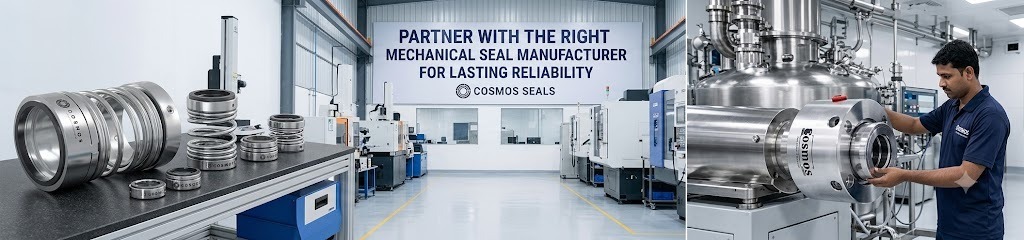
How Cosmos Seals Stands Apart from Typical Suppliers
Cosmos Seals follows an application-first approach rather than a product-first approach, which sets it apart from many conventional suppliers. Instead of supplying seals based only on size or immediate availability, the team evaluates operating media, shaft speed, pressure conditions, and equipment duty before recommending a solution. This ensures that whether the requirement is for a component seal, advanced cartridge seals, or a specialized agitator seal, the selection is aligned with actual working conditions.
Many customers approach Cosmos Seals after facing repeated failures with generic replacements. In such cases, the issue is often not the equipment but the mismatch between seal design and application. By analyzing these conditions in detail and recommending suitable products such as Metal Bellow Seal for high-temperature environments or Double Cartridge (DC20) for critical leakage-sensitive applications, Cosmos Seals helps eliminate recurring problems.
The company also emphasizes the importance of system-level solutions. In applications where operating conditions are unstable or demanding, implementing a seal support system becomes essential. Cosmos Seals provides guidance on such integrations, ensuring that seals perform consistently even under fluctuating process conditions.
Additionally, Cosmos Seals supports replacement compatibility for older and imported equipment. This reduces the need for costly modifications while maintaining performance standards. By combining technical expertise with consistent manufacturing quality, the company positions itself not just as a supplier but as a long-term maintenance partner for industries seeking reliability and efficiency.
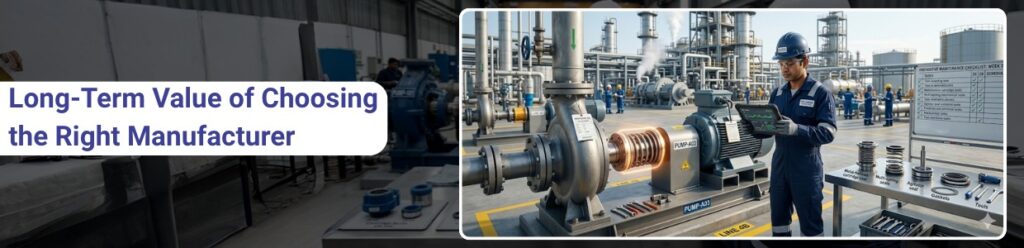
Long-Term Value of Choosing the Right Manufacturer
Selecting the correct sealing manufacturer has a direct impact on maintenance planning, spare consumption, and overall operational stability. While some plants may initially focus on cost, they often realize that choosing a supplier without technical expertise leads to higher long-term expenses due to repeated failures and unplanned downtime. Whether using a basic component seal or advanced cartridge seals, correct selection plays a crucial role in determining performance outcomes.
Manufacturers who provide engineering-driven solutions help plants move toward predictable maintenance cycles. By recommending the right products such as a Multi Spring Seal for high-pressure applications or a Single Agitator (ASC10) for mixing systems, they ensure that seals perform reliably over extended periods. In demanding conditions, combining these solutions with a seal support system further enhances performance by maintaining optimal operating conditions.
The long-term benefits go beyond just seal life. Reliable sealing protects critical equipment components such as shafts, bearings, and housings, reducing wear and extending machinery lifespan. It also improves production continuity by minimizing unexpected shutdowns, allowing operations to run smoothly without interruptions.
Over time, industries that partner with technically capable manufacturers experience a shift from reactive maintenance to a more structured and preventive approach. Instead of constantly addressing breakdowns, maintenance teams can focus on optimization and efficiency. This transition not only reduces operational stress but also contributes to higher productivity, improved safety, and better overall plant performance.
Speak with the Cosmos Seals Engineering Team
If you are evaluating a list of mechanical seal manufacturers, the right decision goes beyond comparing products — it’s about choosing a partner who understands your application and delivers long-term reliability. At Cosmos Seals, we don’t just supply seals; we provide engineered solutions tailored to your operating conditions.
Many industries approach us after facing repeated failures with conventional suppliers. By focusing on root-cause analysis and correct seal selection, we help eliminate recurring breakdowns, reduce maintenance costs, and improve overall equipment efficiency.
If you’re looking for more than just a supplier — a partner who can improve uptime, reliability, and performance — connect with Cosmos Seals today.
The Critical Role of Mechanical Seals in Oil and Gas Operations The oil and gas industry operates under some of the most demanding conditions, where equipment reliability and safety are extremely important. Pumps, compressors, and rotating machinery handle high pressure, extreme temperatures, and aggressive fluids, making mechanical seals an essential component for preventing leakage and […]
Introduction longer equipment life, and reduced maintenance costs in industrial applications. Whether used in pumps, mixers, compressors, or process equipment, the correct seal material and design directly influence the efficiency and reliability of rotating machinery. Selecting the wrong elastomer can lead to premature seal failure, costly downtime, and frequent replacements. Industries such as chemical processing, […]
Introduction In today’s fast-paced industrial environment, machinery is expected to deliver consistent performance with minimal downtime. One of the most important yet often overlooked components that contribute to this reliability is the Low Friction Mechanical Seal. These advanced sealing solutions reduce wear, minimize energy consumption, and improve equipment efficiency across a wide range of industries. […]
In modern industries, maintaining the efficiency and reliability of rotating equipment is essential for smooth operations. Cartridge mechanical seals have become a preferred sealing solution across various sectors due to their easy installation, improved performance, and ability to handle challenging operating conditions. These advanced seals help prevent leakage, reduce maintenance requirements, and enhance the overall […]
High-temperature industrial applications demand sealing solutions that can withstand extreme heat, pressure, and challenging operating conditions without compromising performance. Whether in chemical processing, power generation, oil & gas, pharmaceuticals, or manufacturing plants, selecting the right high-temperature mechanical seals is crucial for maintaining equipment reliability and preventing costly downtime. A poorly selected seal can lead to […]
Introduction In industries where reliability, precision, and efficiency are non-negotiable, choosing the right sealing solution can significantly impact equipment performance. Metal Bellow Mechanical Seals are engineered to provide exceptional sealing capabilities in demanding environments where conventional seals may fail. Designed without dynamic elastomers, these seals utilize precision-formed metallic bellows that accommodate thermal expansion, shaft movement, […]